Marginal Benefit Curve Slope Shows the Relationship Between the Peer Reviewed Articles
vi.1 The Logic of Maximizing Behavior
Learning Objectives
- Explain the maximization assumption that economists make in explaining the behavior of consumers and firms.
- Explain and illustrate the concepts of marginal benefit and marginal cost and apply them to understanding the marginal determination rule.
To say that individuals maximize is to say that they pick some objective and so seek to maximize its value. A sprinter might want to maximize his or her speed; a politician might want to maximize the probability that he or she will win the next ballot. Economists pay special attention to two groups of maximizers: consumers and firms. Nosotros assume that consumers seek to maximize utility and that firms seek to maximize economical profit, which is the deviation between total revenue and total price. The costs involved in this concept of economic profit are computed in the economical sense—every bit the opportunity costs, or value of the best opportunity forgone.
The assumption of maximizing behavior lies at the heart of economical analysis. As we explore its implications, even so, we must keep in mind the stardom between models and the real world. Our model assumes that individuals brand choices in a way that achieves a maximum value for some conspicuously defined objective. In using such a model, economists practise not presume that people actually become through the calculations we will describe. What economists practice fence is that people'south beliefs is broadly consequent with such a model. People may not consciously seek to maximize anything, simply they behave every bit though they practise.
The Analysis of Maximizing Behavior
The activities of consumers and firms take benefits, and they as well have opportunity costs. Nosotros presume that given these benefits and costs, consumers and firms will make choices that maximize the internet benefit of each activity—the total benefit of the activity minus its opportunity cost. The specific measures of do good and cost vary with the kind of option being made. In the case of a firm's choices in product, for example, the full benefit of production is the revenue a house receives from selling the product; the total cost is the opportunity cost the firm incurs by producing it. The net do good is thus total revenue minus total opportunity cost, or economic profit.
Economists maintain that in society to maximize net benefit, consumers and firms evaluate each action at the margin—they consider the additional benefit and the additional toll of another unit of the activeness. Should you lot "supersize" your social club at McDonald's? Will the additional beverage and the additional french fries exist worth the actress toll? Should a firm hire i more worker? Will the benefits to the firm of hiring this worker be worth the additional cost of hiring him or her?
The marginal do good is the amount by which an additional unit of an activity increases its full benefit. It is the amount past which the actress french fries increment your satisfaction, or the extra revenue the firm expects to bring in by hiring another worker. The marginal cost is the amount by which an additional unit of measurement of an action increases its total cost. You will pay more than to supersize your McDonald's order; the firm'south labor costs volition rise when information technology hires another worker.
To determine the quantity of any action that will maximize its net benefit, we apply the marginal decision rule: If the marginal benefit of an additional unit of measurement of an action exceeds the marginal toll, the quantity of the activity should be increased. If the marginal benefit is less than the marginal cost, the quantity should exist reduced. Cyberspace benefit is maximized at the point at which marginal benefit equals marginal cost. The marginal conclusion rule is at the middle of the economical way of thinking. The dominion basically says this: If the additional do good of ane more unit exceeds the extra cost, do it; if non, do not. This unproblematic logic gives the states a powerful tool for the analysis of choice. Perhaps more than whatever other rule in economical assay, the marginal decision dominion typifies the style in which economists clarify issues. We shall employ information technology in every chapter that follows in the microeconomics portion of this text.
Maximizing choices must be fabricated within the parameters imposed by some constraint, which is a boundary that limits the range of choices that can be made. We assume that a consumer seeks the greatest satisfaction possible inside the limits of his or her income or budget. A firm cannot produce beyond the limits of its production capacity at a point in time.
The marginal decision rule forms the foundation for the structure economists apply to analyze all choices. At kickoff glance, it may seem that a consumer seeking satisfaction from, say, pizza has little in mutual with an entrepreneur seeking profit from the production of custom-designed semiconductors. Simply maximizing choices ever follow the marginal decision dominion—and that rule holds regardless of what is existence maximized or who is doing the maximizing.
To see how the logic of maximizing choices works, nosotros volition examine a specific trouble. We will then extend that problem to the general assay of maximizing choices.
A Problem in Maximization
Suppose a college student, Laurie Phan, faces two midterms tomorrow, i in economics and another in bookkeeping. She has already decided to spend 5 hours studying for the 2 examinations. This decision imposes a constraint on the problem. Suppose that Ms. Phan's goal is to allocate her 5 hours of study so that she increases her total score for the ii exams past as much as possible.
Ms. Phan expects the relationship between the time she spends studying for the economics examination and the total gain in her score to be as given by the second row of the table in Panel (a) of Figure vi.1 "The Benefits of Studying Economics". We interpret the expected full proceeds in her score as the full benefit of study. She expects that i hour of study will heighten her score by 18 points; two hours will raise it past 32 points, and so on. These values are plotted in Panel (b). Notice that the total do good bend rises, but by smaller and smaller amounts, as she studies more and more than. The slope of the curve, which in this example tells us the rate at which her expected score rises with increased study time, falls equally nosotros travel upwards and to the right forth the curve.
Figure 6.1 The Benefits of Studying Economics
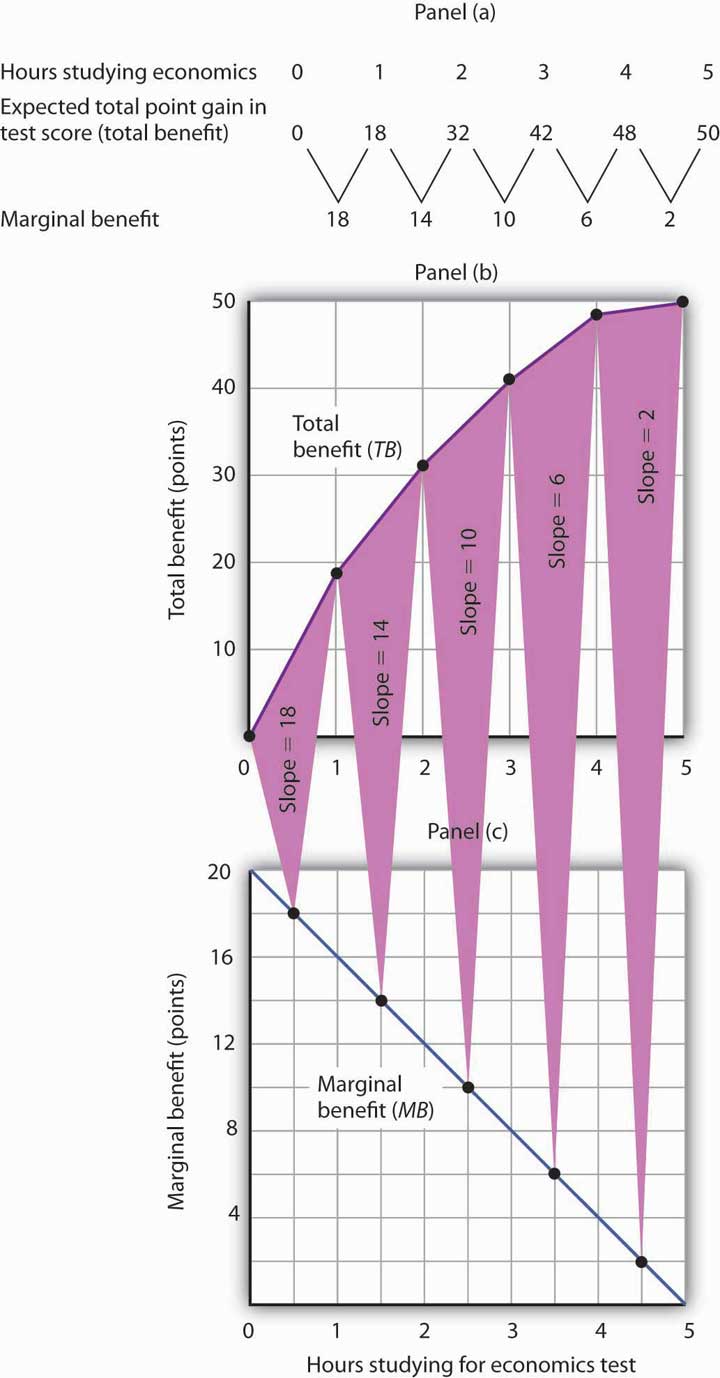
The tabular array in Console (a) shows the total benefit and marginal benefit of the fourth dimension Laurie Phan spends studying for her economics exam. Panel (b) shows the total benefit curve. Panel (c) shows the marginal do good curve, which is given by the slope of the total benefit curve in Panel (b).
Now expect at the 3rd row in the table in Console (a). It tells the states the amount by which each additional 60 minutes of report increases her expected score; it gives the marginal benefit of studying for the economic science exam. Marginal benefit equals the amount by which total do good rises with each additional hr of study. Because these marginal benefits are given by the changes in total benefits from additional hours of study, they equal the slope of the total benefit bend. We see this in the human relationship between Panels (b) and (c) of Figure 6.1 "The Benefits of Studying Economics". The decreasing slope of the total do good curve in Panel (b) gives us the downward-sloping marginal do good bend in Console (c).
The marginal benefit curve tells us what happens when we pass from one signal to another on the full benefit curve, and so we have plotted marginal benefits at the midpoints of the hourly intervals in Panel (c). For instance, the total benefit curve in Panel (b) tells us that, when Ms. Phan increases her time studying for the economics examination from two hours to 3 hours, her full benefit rises from 32 points to 42 points. The increase of ten points is the marginal do good of increasing report time for the economics test from two hours to 3 hours. We marker the indicate for a marginal benefit of ten points midway betwixt 2 and iii hours. Because marginal values tell us what happens equally we laissez passer from one quantity to the next, nosotros shall ever plot them at the midpoints of intervals of the variable on the horizontal axis.
We can perform the same kind of analysis to obtain the marginal benefit curve for studying for the accounting test. Figure 6.2 "The Marginal Benefits of Studying Accounting" presents this curve. Like the marginal benefit curve for studying economics, information technology slopes downward. Once again, nosotros have plotted marginal values at the midpoints of the intervals. Increasing study time in bookkeeping from 0 to 1 hr increases Ms. Phan's expected accounting score past fourteen points.
Figure 6.2 The Marginal Benefits of Studying Accounting
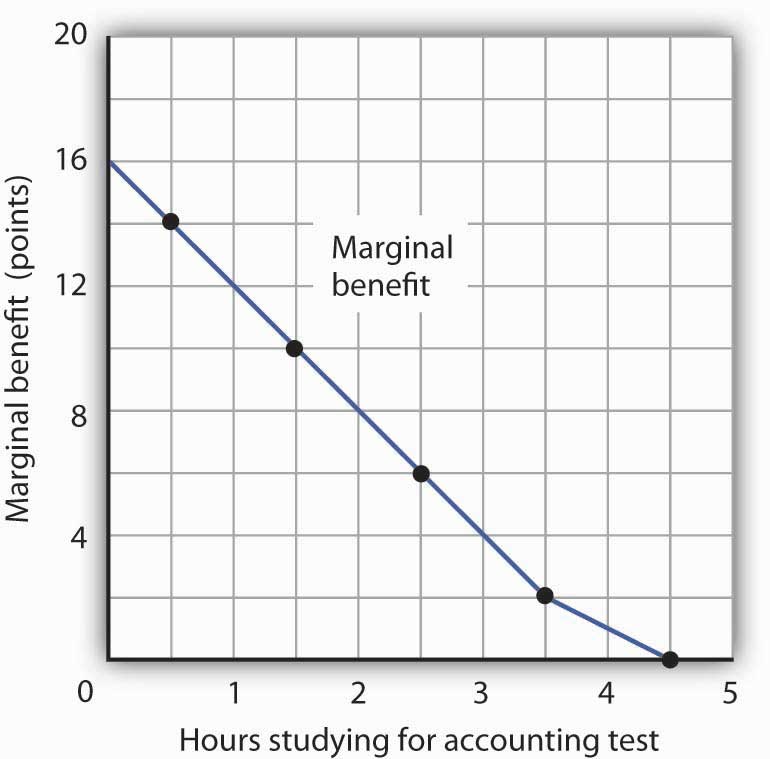
The marginal benefit Laurie Phan expects from studying for her accounting examination is shown by the marginal benefit curve. The starting time hour of written report increases her expected score past 14 points, the second hour past ten points, the third by 6 points, and so on.
Ms. Phan's marginal benefit curves for studying typify a general miracle in economics. Marginal benefit curves for nigh all activities, including the activities of consumers and of firms, slope downward. Retrieve most your ain feel with studying. On a given day, the first hour spent studying a certain subject area probably generates a greater marginal benefit than the second, and the second 60 minutes probably generates a greater marginal benefit than the third. Y'all may reach a betoken at which an extra hour of study is unlikely to yield any benefit at all. Of course, our example of Laurie Phan's expected exam scores is a highly stylized 1. One could hardly await a student to take a precise set of numbers to guide him or her in allocating written report time. Just information technology is certainly the case that students take a rough idea of the probable payoff of report fourth dimension in different subjects. If you were faced with exams in 2 subjects, information technology is likely that you would gear up aside a certain amount of study fourth dimension, only as Ms. Phan did in our example. And it is probable that your own feel would serve every bit a guide in determining how to allocate that time. Economists practise not assume that people have numerical scales in their heads with which to draw marginal benefit and marginal price curves. They merely assume that people human activity as if they did.
The nature of marginal benefits can change with dissimilar applications. For a eating place, the marginal do good of serving i more than repast tin can be defined as the revenue that repast produces. For a consumer, the marginal benefit of one more slice of pizza can be considered in terms of the additional satisfaction the pizza will create. But whatever the nature of the benefit, marginal benefits by and large fall as quantities increase.
Ms. Phan's falling marginal do good from hours spent studying bookkeeping has special significance for our analysis of her pick apropos how many hours to devote to economics. In our trouble, she had decided to devote 5 hours to studying the two subjects. That ways that the opportunity toll of an 60 minutes spent studying economics equals the benefit she would have gotten spending that hr studying accounting.
Suppose, for instance, that she were to consider spending all v hours studying accounting. The marginal do good curve for studying for her accounting test tells us that she expects that the fifth hour will add nothing to her score. Shifting that hour to economic science would toll aught. Nosotros tin can say that the marginal toll of the first hour spent studying economics is cipher. We obtained this value from the marginal benefit curve for studying accounting in Figure 6.2 "The Marginal Benefits of Studying Bookkeeping".
Similarly, nosotros tin can detect the marginal toll of the second hr studying economics. That requires giving up the fourth hour spent on accounting. Figure half dozen.ii "The Marginal Benefits of Studying Accounting" tells us that the marginal benefit of that hour equals 2—that is the marginal toll of spending the 2nd hr studying economics.
Figure vi.iii "The Marginal Benefits and Marginal Costs of Studying Economic science" shows the marginal price curve of studying economics. Nosotros see that at first, time devoted to studying economics has a low marginal cost. As time spent studying economics increases, however, it requires her to give upwardly study time in accounting that she expects will exist more and more productive. The marginal cost curve for studying economics tin thus be derived from the marginal do good curve for studying accounting. Figure six.three "The Marginal Benefits and Marginal Costs of Studying Economics" also shows the marginal do good bend for studying economic science that we derived in Panel (b) of Effigy vi.1 "The Benefits of Studying Economics".
Figure six.3 The Marginal Benefits and Marginal Costs of Studying Economics
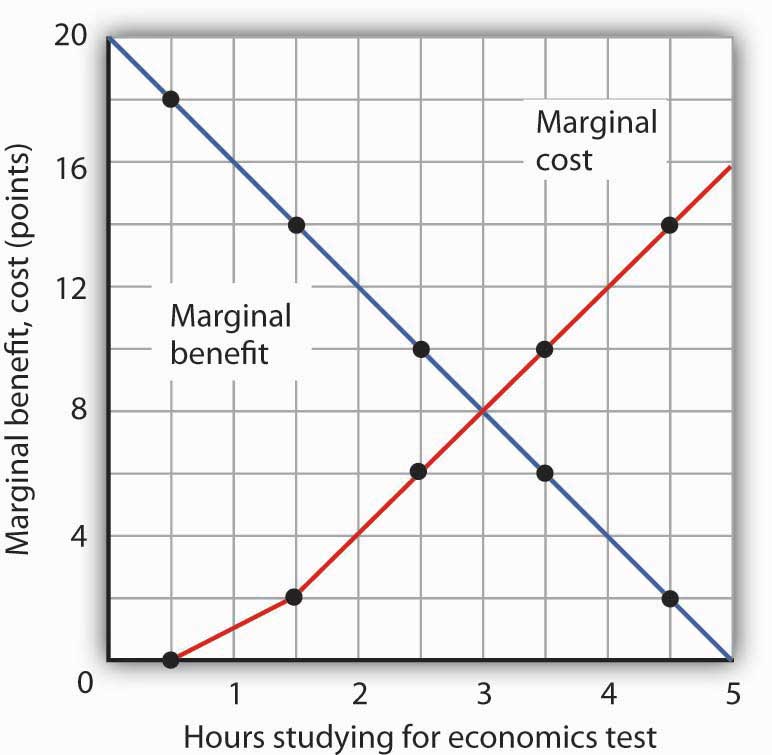
The marginal benefit curve from Panel (c) of Effigy 6.1 "The Benefits of Studying Economics" is shown together with the marginal costs of studying economics. The marginal cost curve is derived from the marginal benefit curve for studying accounting shown in Figure 6.ii "The Marginal Benefits of Studying Bookkeeping".
Just as marginal benefit curves generally slope downward, marginal cost curves generally slope upward, equally does the one in Figure 6.iii "The Marginal Benefits and Marginal Costs of Studying Economics". In the case of allocating time, the phenomenon of rising marginal cost results from the simple fact that, the more than fourth dimension a person devotes to one activity, the less time is available for some other. And the more one reduces the second activity, the greater the forgone marginal benefits are likely to be. That means the marginal toll curve for that first activity rises.
Because nosotros now have marginal benefit and marginal cost curves for studying economic science, we tin can apply the marginal decision rule. This rule says that, to maximize the net benefit of an activity, a decision maker should increase an activity upward to the point at which marginal benefit equals marginal cost. That occurs where the marginal benefit and marginal cost curves intersect, with 3 hours spent studying economics and ii hours spent studying bookkeeping.
Using Marginal Benefit and Marginal Toll Curves to Notice Cyberspace Benefits
Nosotros can apply marginal benefit and marginal cost curves to show the full benefit, the total cost, and the net do good of an activity. We volition encounter that equating marginal do good to marginal toll does, indeed, maximize net benefit. We will also develop another tool to utilise in interpreting marginal benefit and toll curves.
Panel (a) of Figure 6.four "The Benefits and Costs of Studying Economic science" shows the marginal benefit bend we derived in Panel (c) of Figure 6.one "The Benefits of Studying Economics". The corresponding point on the marginal benefit curve gives the marginal benefit of the first 60 minutes of written report for the economics examination, 18 points. This same value equals the area of the rectangle bounded past 0 and 1 hour of study and the marginal benefit of 18. Similarly, the marginal do good of the second hour, fourteen points, is shown by the corresponding bespeak on the marginal benefit curve and by the area of the shaded rectangle bounded by 1 and 2 hours of report. The total benefit of 2 hours of study equals the sum of the areas of the first 2 rectangles, 32 points. We keep this procedure through the fifth hr of studying economics; the areas for each of the shaded rectangles are shown in the graph.
Effigy vi.4 The Benefits and Costs of Studying Economic science

Panel (a) shows the marginal benefit curve of Figure half-dozen.i "The Benefits of Studying Economics". The total benefit of studying economics at whatever given quantity of study time is given approximately by the shaded expanse below the marginal benefit curve up to that level of study. Panel (b) shows the marginal price curve from Effigy six.three "The Marginal Benefits and Marginal Costs of Studying Economic science". The total price of studying economics at any given quantity of study is given approximately by the shaded surface area below the marginal cost curve upwards to that level of study.
Two features of the curve in Panel (a) of Figure 6.iv "The Benefits and Costs of Studying Economic science" are particularly important. Start, note that the sum of the areas of the five rectangles, 50 points, equals the total benefit of v hours of study given in the tabular array in Panel (a) of Figure six.1 "The Benefits of Studying Economic science". Second, notice that the shaded areas are approximately equal to the area under the marginal benefit curve betwixt 0 and v hours of study. We can pick any quantity of study fourth dimension, and the total do good of that quantity equals the sum of the shaded rectangles between null and that quantity. Thus, the full benefit of 2 hours of study equals 32 points, the sum of the areas of the first two rectangles.
Now consider the marginal price bend in Panel (b) of Figure 6.4 "The Benefits and Costs of Studying Economics". The areas of the shaded rectangles equal the values of marginal cost. The marginal cost of the offset hr of study equals aught; in that location is thus no rectangle nether the curve. The marginal price of the 2d hr of study equals 2 points; that is the area of the rectangle divisional past 1 and 2 hours of report and a marginal toll of 2. The marginal toll of the third hour of study is 6 points; this is the area of the shaded rectangle bounded past ii and three hours of study and a marginal cost of half-dozen.
Looking at the rectangles in Panel (b) over the range of 0 to 5 hours of written report, we see that the areas of the 5 rectangles total 32, the total toll of spending all 5 hours studying economics. And looking at the rectangles, we see that their surface area is approximately equal to the area under the marginal price bend between 0 and 5 hours of study.
Nosotros have seen that the areas of the rectangles fatigued with Laurie Phan's marginal benefit and marginal cost curves equal the total do good and total cost of studying economic science. We have as well seen that these areas are roughly equal to the areas under the curves themselves. Nosotros can make this last statement much stronger. Suppose, instead of thinking in intervals of whole hours, we think in terms of smaller intervals, say, of 12 minutes. Then each rectangle would exist only 1-5th as broad every bit the rectangles we drew in Effigy vi.4 "The Benefits and Costs of Studying Economics". Their areas would even so equal the total benefit and total cost of report, and the sum of those areas would exist closer to the area under the curves. We take done this for Ms. Phan's marginal benefit bend in Figure 6.5 "The Marginal Benefit Bend and Total Do good"; find that the areas of the rectangles closely approximate the area under the curve. They still "stick out" from either side of the bend as did the rectangles we drew in Figure 6.4 "The Benefits and Costs of Studying Economic science", but you almost need a magnifying glass to see that. The smaller the interval we choose, the closer the areas under the marginal benefit and marginal cost curves will be to total benefit and total cost. For purposes of our model, we tin can imagine that the intervals are equally small-scale as we like. Over a particular range of quantity, the surface area nether a marginal benefit curve equals the total benefit of that quantity, and the area under the marginal cost bend equals the total cost of that quantity.
Figure 6.5 The Marginal Benefit Curve and Full Benefit
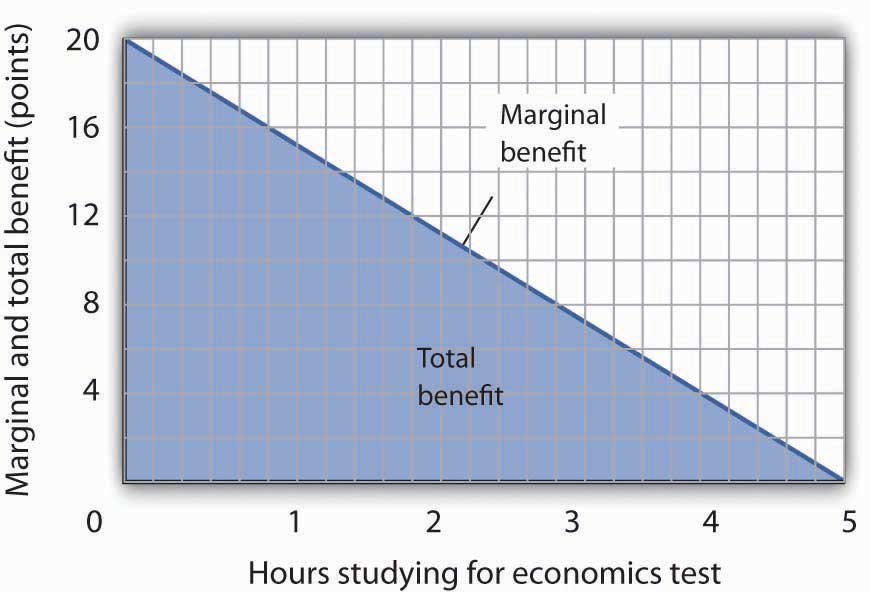
When the increments used to measure time allocated to studying economics are made smaller, in this instance 12 minutes instead of whole hours, the expanse under the marginal benefit curve is closer to the total benefit of studying that corporeality of time.
Panel (a) of Figure 6.6 "Using Marginal Do good and Marginal Cost Curves to Determine Net Do good" shows marginal benefit and marginal cost curves for studying economics, this time without numbers. We take the usual downward-sloping marginal benefit curve and up-sloping marginal price bend. The marginal decision rule tells united states of america to choose D hours studying economic science, the quantity at which marginal do good equals marginal cost at indicate C. Nosotros know that the total benefit of study equals the surface area under the marginal benefit bend over the range from A to D hours of study, the surface area ABCD. Total cost equals the area under the marginal price curve over the same range, or ACD. The difference between total benefit and total cost equals the area betwixt marginal benefit and marginal cost between A and D hours of study; it is the green-shaded triangle ABC. This difference is the net do good of time spent studying economics. Panel (b) of Effigy vi.6 "Using Marginal Benefit and Marginal Cost Curves to Determine Internet Benefit" introduces another important concept. If an activity is carried out at a level less than the efficient level, so cyberspace benefits are forgone. The loss in net benefits resulting from a failure to conduct out an activity at the efficient level is called a deadweight loss.
Figure 6.6 Using Marginal Benefit and Marginal Cost Curves to Determine Net Do good
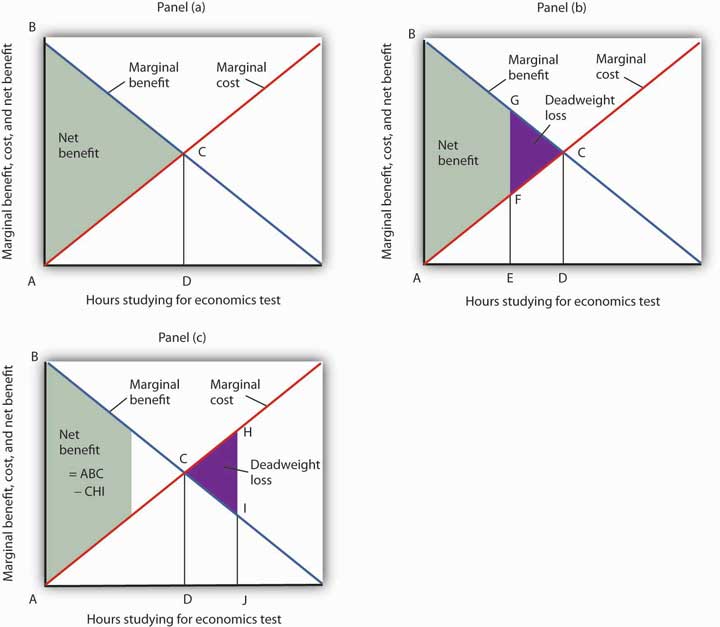
In Panel (a) internet benefits are given by the divergence between total benefits (as measured by the area under the marginal benefit bend up to any given level of activity) and total costs (every bit measured by the surface area under the marginal price curve upwards to whatsoever given level of activeness). Maximum net benefits are found where the marginal do good curve intersects the marginal cost curve at action level D. Panel (b) shows that if the level of the activity is restricted to activity level Due east, net benefits are reduced from the dark-green shaded triangle ABC in Console (a) to the smaller surface area ABGF. The forgone net benefits, or deadweight loss, is given past the purple-shaded expanse FGC. If the action level is increased from D to J, every bit shown in Panel (c), net benefits declined by the deadweight loss measured by the area CHI.
At present suppose a person increases study fourth dimension from D to J hours as shown in Panel (c). The area nether the marginal cost curve between D and J gives the total price of increasing study time; information technology is DCHJ. The total benefit of increasing report time equals the expanse nether the marginal benefit bend betwixt D and J; it is DCIJ. The price of increasing study time in economics from D hours to J hours exceeds the do good. This gives us a deadweight loss of CHI. The internet benefit of spending J hours studying economics equals the net benefit of studying for D hours less the deadweight loss, or ABC minus CHI. Only by studying upwards to the point at which marginal do good equals marginal cost do we accomplish the maximum internet do good shown in Panel (a).
We tin can utilise the marginal decision rule to the problem in Effigy 6.half dozen "Using Marginal Benefit and Marginal Price Curves to Determine Net Benefit" in another way. In Panel (b), a person studies economics for Due east hours. Reading up to the marginal benefit curve, we reach signal G. Reading upward to the marginal cost curve, nosotros reach point F. Marginal benefit at Chiliad exceeds marginal cost at F; the marginal decision dominion says economic science study should be increased, which would take united states toward the intersection of the marginal do good and marginal cost curves. Spending J hours studying economics, equally shown in Panel (c), is too much. Reading upwards to the marginal benefit and marginal cost curves, we see that marginal cost exceeds marginal do good, suggesting that study time be reduced.
This completes our introduction to the marginal decision rule and the use of marginal benefit and marginal toll curves. We will spend the remainder of the chapter applying the model.
Heads Upward!
It is piece of cake to make the mistake of assuming that if an action is carried out up to the point where marginal benefit equals marginal cost, then net benefits must exist zero. Think that following the marginal decision dominion and equating marginal benefits and costs maximizes cyberspace benefits. It makes the departure between total benefits and full cost as large as possible.
Cardinal Takeaways
- Economists assume that decision makers make choices in the way that maximizes the value of some objective.
- Maximization involves determining the change in total benefit and the change in total cost associated with each unit of an activity. These changes are chosen marginal do good and marginal toll, respectively.
- If the marginal benefit of an activity exceeds the marginal cost, the determination maker will gain past increasing the activeness.
- If the marginal price of an activity exceeds the marginal benefit, the decision maker will proceeds by reducing the activeness.
- The area under the marginal benefit bend for an activeness gives its full do good; the area nether the marginal cost curve gives the activity's total cost. Net benefit equals total benefit less total toll.
- The marginal benefit rule tells us that we can maximize the internet do good of whatsoever activity by choosing the quantity at which marginal benefit equals marginal cost. At this quantity, the internet benefit of the activity is maximized.
Try It!
Suppose Ms. Phan still faces the exams in economics and in accounting, and she still plans to spend a total of five hours studying for the two exams. However, she revises her expectations near the degree to which studying economic science and bookkeeping volition bear on her scores on the two exams. She expects studying economics will add somewhat less to her score, and she expects studying accounting will add more than. The issue is the table below of expected full benefits and full costs of hours spent studying economics. Notice that several values in the tabular array have been omitted. Fill in the missing values in the table. How many hours of study should Ms. Phan devote to economics to maximize her cyberspace do good?
| Hours studying economics | 0 | i | 2 | 3 | 4 | 5 |
| Total benefit | 0 | 14 | 24 | 30 | 32 | |
| Total cost | 0 | 2 | viii | 32 | fifty | |
| Net benefit | 0 | 12 | 12 | 0 | −xviii |
Now compute the marginal benefits and costs of hours devoted to studying economic science, completing the table below.
Figure 6.vii
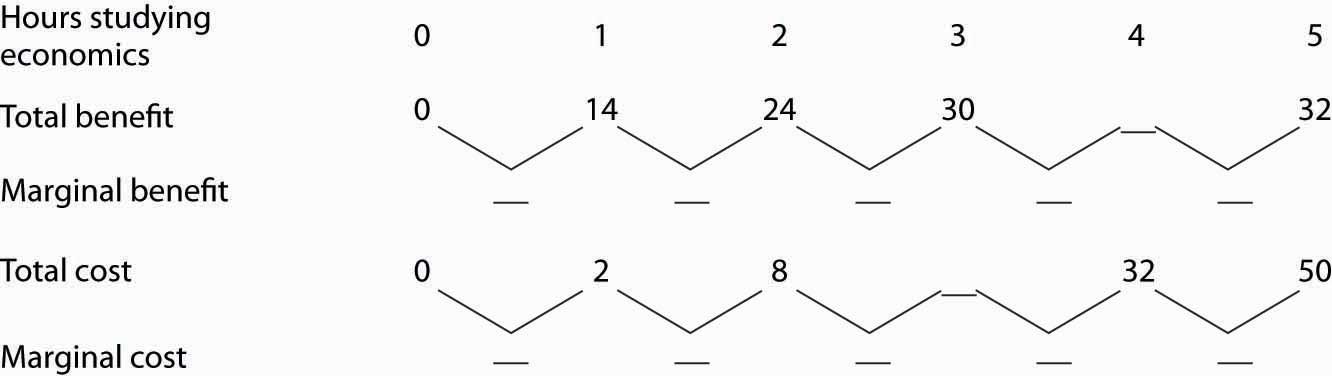
Draw the marginal benefit and marginal toll curves for studying economics (recall to plot marginal values at the midpoints of the respective hourly intervals). Practise your curves intersect at the "right" number of hours of study—the number that maximizes the net do good of studying economic science?
Example in Betoken: Preventing Oil Spills
Figure half-dozen.8

Do we spill enough oil in our oceans and waterways? Information technology is a question that perhaps only economists would enquire—and, equally economists, we should ask information technology.
There is, of class, no virtue in an oil spill. It destroys wildlife and fouls shorelines. Cleanup costs can be tremendous. Withal, Preventing oil spills has costs every bit well: greater enforcement expenditures and higher costs to shippers of oil and, therefore, higher costs of goods such as gasoline to customers. The only way to preclude oil spills completely is to stop shipping oil. That is a cost few people would accept. But what is the right balance between environmental protection and the satisfaction of consumer demand for oil?
Vanderbilt University economist Mark Cohen examined the U.S. Coast Guard'due south efforts to reduce oil spills through its enforcement of aircraft regulations in coastal waters and on rivers. He focused on the costs and benefits resulting from the Coast Guard's enforcement efforts in 1981. On the basis of the frequency of oil spills earlier the Coast Guard began its enforcement, Mr. Cohen estimated that the Coast Guard prevented 1,159,352 gallons of oil from beingness spilled in 1981.
Given that there was a full of 824,921 gallons of oil actually spilled in 1981, should the Coast Guard have attempted to prevent fifty-fifty more spillage? Mr. Cohen estimated that the marginal do good of preventing ane more gallon from beingness spilled was $7.27 ($3.42 in cleanup costs, $three less in environmental damage, and $0.85 worth of oil saved). The marginal cost of preventing ane more gallon from being spilled was $v.50. Mr. Cohen suggests that because the marginal benefit of more than vigorous enforcement exceeded the marginal toll, more vigorous Declension Guard efforts would have been justified.
More vigorous efforts accept, indeed, been pursued. In 1989, the Exxon oil tanker Exxon Valdez ran aground, spilling ten.viii million gallons of oil off the coast of Alaska. The spill damaged the shoreline of a national forest, 4 national wild fauna refuges, three national parks, five state parks, iv disquisitional habitat areas, and a state game refuge. Exxon was ordered to pay $900 meg in damages; a federal jury found Exxon and the captain guilty of criminal negligence and imposed an additional $five billion in punitive damages. In 2008, The Supreme Court reduced the assessment of castigating amercement to $507 million, with the majority arguing that the original effigy was likewise high in comparison to the compensatory damages for a instance in which the actions of the defendant, Exxon, were "reprehensible" just not intentional.
Maybe the most important touch on of the Exxon Valdez disaster was the passage of the Oil Pollution Act of 1990. It increased shipper liability from $fourteen million to $100 million. It also required double-hulled tankers for shipping oil.
The European union (EU) has also strengthened its standards for oil tankers. The 2002 breakup of the oil tanker Prestige off the coast of Kingdom of spain resulted in the spillage of 3.2 million gallons of oil. The EU had planned to ban single-hulled tankers, phasing in the ban between 2003 and 2015. The sinking of the Prestige led the Eu to move up that deadline.
Spill crises have led both the The states and the European Spousal relationship to tighten up their regulations of oil tankers. The result has been a reduction in the quantity of oil spilled, which was precisely what economic research had ended was needed. By 2002, the amount of oil spilled per barrel shipped had fallen 30% from the level three decades earlier.
Sources: Mark A. Cohen, "The Costs and Benefits of Oil Spill Prevention and Enforcement," Journal of Environmental Economics and Direction thirteen(2) (June 1986): 167–188; Rick S. Kurtz, "Coastal Oil Pollution: Spills, Crisis, and Policy Modify," Review of Policy Research, 21(2) (March 2004): 201–219; David S. Cruel, "Justices Slash Exxon Valdez Verdict," Los Angeles Times, June 26, 2008, p. A1; and Edwin Unsworth, "Europe Gets Tougher on Aging Oil Tankers," Business Insurance, 36(48) (December 2, 2002): 33–34.
Answer to Try It! Problem
Here are the completed data table and the table showing total and marginal benefit and cost.
Figure six.9
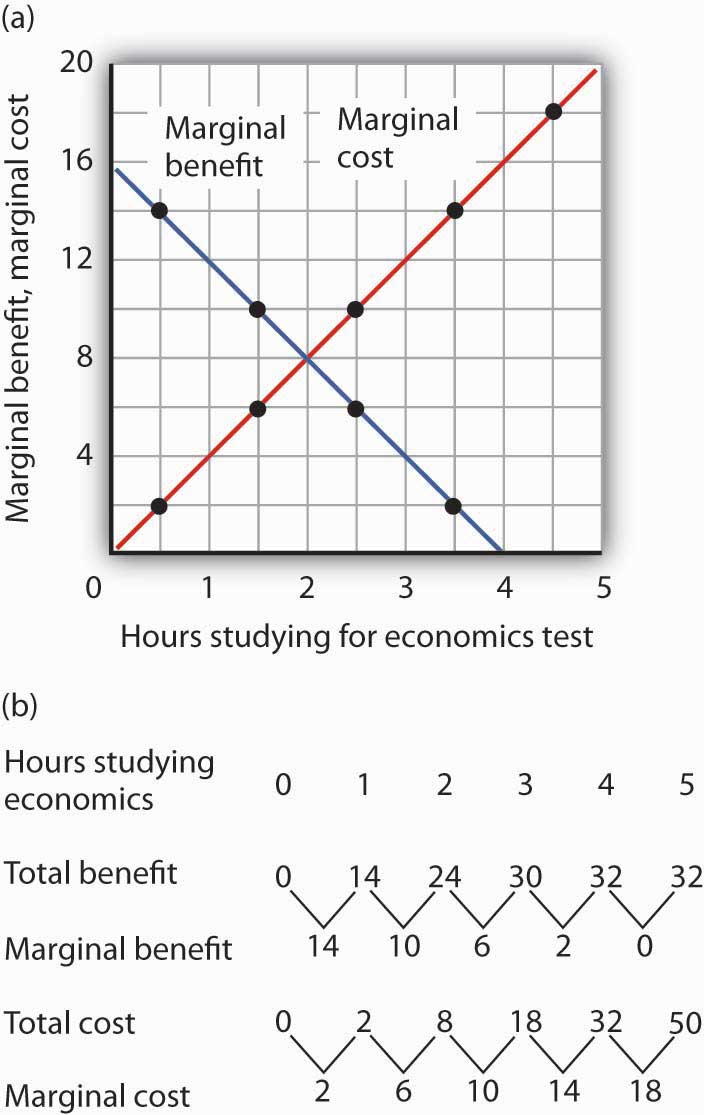
Ms. Phan maximizes her net benefit by reducing her time studying economics to 2 hours. The change in her expectations reduced the benefit and increased the cost of studying economics. The completed graph of marginal benefit and marginal price is at the far left. Discover that answering the question using the marginal decision dominion gives the same answer.
Source: https://open.lib.umn.edu/principleseconomics/chapter/6-1-the-logic-of-maximizing-behavior/
0 Response to "Marginal Benefit Curve Slope Shows the Relationship Between the Peer Reviewed Articles"
Enviar um comentário