Frida Kahlo Selfportrait With Thorn Necklace and Hummingbird Michelangelo Art
| Self-Portrait with Thorn Necklace and Hummingbird | |
|---|---|
| Spanish: Autorretrato con Collar de Espinas | |
 | |
| Artist | Frida Kahlo |
| Yr | 1940 |
| Medium | Oil on canvas |
| Dimensions | 61.25 lookin cm × 47 cm (24.11 in × 18.5 in) |
| Location | Harry Ransom Center, Austin, Texas, Austin |
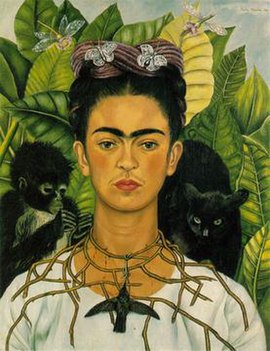
Self-Portrait with Thorn Necklace and Hummingbird (Autorretrato con Neckband de Espinas) is a 1940 painting by Mexican painter Frida Kahlo.
Kahlo painted the self-portrait, which includes a black cat and a monkey, after her divorce from Diego Rivera and the terminate of her thing with photographer Nickolas Muray. Muray bought the portrait before long later it was painted, and it is currently part of the Nickolas Muray collection at the Harry Ransom Heart at the University of Texas at Austin.[1]
Background [edit]
Frida Kahlo was a Mexican painter active between 1925 and 1954. She began painting while crippled due to a bus accident that left her seriously injured. Nearly of her piece of work consists of self-portraits, which deal directly with her struggle with medical issues, infertility, and her troubeparate Frida on which to project her anguish and pain.[ii] Scholars accept interpreted her self-portraits as a mode for Kahlo to reclaim her body from medical problems and gender conformity. In particular, scholars have interpreted her cocky-portraits in the context of the tradition of male European artists using the female body as the subject of their paintings and an object of desire.[3] Kahlo, using her own image, reclaims this use from the patriarchal tradition. The autobiographical details of her life found in these works also as her characteristic brows, elaborate hair, and vibrant Mexican clothing has made her a pop figure in Mexico and the Us.
Kahlo was a big supporter of the Mexican Revolution, so much so that she attempted to change her nascence appointment to stand for with the outset of the Revolution in 1910.[2] At the onset of this move, a so-called "cult of Mexican femininity" gained popularity, which Jolie Olcott describes as "selflessness, martyrdom, self-sacrifice, an erasure of self and the negation of ane's outward beingness."[4] In rejection of this limited conception of femininity, Kahlo fashioned herself every bit a Mexican counterpart to the flappers of the United States and Europe in the 1920s. Later, inspired past Rivera's concept of Mexicanidad, a passionate identification with Mexican pre-Hispanic indigenous roots, she donned the identity of the Tehuana woman.[2] The Tehuana had a smashing bargain of equality with their male person Zapotec counterparts and represented strength, sensuality, and exoticism.[5]
What should the say?
Symbolism [edit]
Kahlo's identification with indigenous Mexican culture afflicted her painting aesthetic. By using powerful iconography from indigenous Mexican civilisation, Kahlo situates herself in a tradition of rebellion confronting colonial forces and male dominion.[5] The dead hummingbird which hangs effectually her neck is considered a good luck charm for falling in beloved in Mexican sociology.[6] An culling interpretation is that the hummingbird pendant is a symbol of Huitzilopochtli, the Aztec god of war.[7] Meanwhile, the black panther is symbolic of bad luck and death and the monkey is a symbol of evil.[vi] The natural landscape, which normally symbolizes fertility, contrasts with the deathly imagery in the foreground. Rivera gave Kahlo a spider monkey every bit a gift, thus suggesting that it could be a symbol of Rivera, particularly since he inflicts pain upon Kahlo past tugging the thorn necklace hard enough to make her drain.[6] Alternatively, the thorn necklace could allude to Christ's crown of thorns, thus likening herself to a Christian martyr, and representing the pain and ache she felt subsequently her failed romantic relationships. In line with this interpretation, the butterflies and dragonflies could symbolize her resurrection.[5]
Exhibition history [edit]
The University of Texas at Austin acquired the painting in 1966. Since 1990, information technology has appeared in several exhibitions internationally:
- "Frida Kahlo," Philadelphia Museum of Art, February 20, 2008 - May 18, 2008[eight]
- Harry Ransom Center, University of Texas at Austin, May five, 2009 - March 21, 2010
- "In Wonderland: The Surrealist Activities of Women Artists in United mexican states and the United States," Los Angeles Canton Museum of Art, Jan 29, 2012 – May 6, 2012;[nine] Musée national des beaux-arts du Québec, Quebec Urban center, June 7, 2012 - September 3, 2012; Museo de Arte Moderno, Mexico Urban center, September 27, 2012 - Jan. 13, 2013.[ten]
- "Frida Kahlo," Scuderie del Quirinale, Rome, March 20, 2014 - August 31, 2014[xi]
- Harry Ransom Center, University of Texas at Austin, September 5, 2014 - April 26, 2015[12]
- "Frida: Art, Garden, Life," New York Botanical Garden, May 16, 2015 - November 1, 2015.[thirteen]
- "Frida Kahlo and Arte Popular," Museum of Fine Arts, Boston, February 27, 2019 - June 19, 2019.[14]
Notes [edit]
- ^ Ditrich, "Self-portrait with Thorn Necklace and Hummingbird".
- ^ a b c Herrera, "Kahlo, Frida".
- ^ Udall, "Frida Kahlo'south Mexican Body," 13.
- ^ Pankl and Blake, "Fabricated in Her Image," 5.
- ^ a b c Pankl and Blake, "Made in Her Image," 8.
- ^ a b c Fuentes and Kahlo, The Diary of Frida Kahlo," 78.
- ^ Baddeley, "Her Apparel Hangs Here," 13.
- ^ "Frida Kahlo". Philadelphia Museum of Art . Retrieved eight March 2015.
- ^ "In Wonderland: The Surrealist Adventures of Women Artists in United mexican states and the United States". Los Angeles County Museum of Art . Retrieved 8 March 2015.
- ^ "Frida Kahlo'south "Self-Portrait with Thorn Necklace and Hummingbird" at Bribe Center in Austin". Art Daily . Retrieved 8 March 2015.
- ^ "Frida Kahlo: List of Works". Scuderie del Quirinale . Retrieved viii March 2015.
- ^ "Frida Kahlo's Self-portrait with Thorn Necklace and Hummingbird". Harry Bribe Heart, Academy of Texas at Austin . Retrieved viii March 2015.
- ^ "Well-nigh the Show: Frida Kahlo: Art, Garden, Life". New York Botanical Garden . Retrieved 8 March 2015.
- ^ "Frida Kahlo and Arte Popular". Museum of Fine Arts, Boston . Retrieved 28 Apr 2019.
References [edit]
- Baddeley, Oriana. "'Her Dress Hangs Here: De-Frocking the Kahlo Cult." Oxford Art Periodical 14, no. one (1991): x–17.
- Dietrich, Alicia. "Frida Kahlo'south "Self-portrait with Thorn Necklace and Hummingbird" back on brandish today." Cultural Compass. February xiv, 2013. Accessed March 21, 2017.
- Fuentes, Carlos and Frida Kahlo. The Diary of Frida Kahlo: An Intimate Self-Portrait. New York: Bloomsbury, 1995.
- Hayden Herrera. "Kahlo, Frida." Grove Art Online. Oxford Art Online. Oxford University Press, accessed March 21, 2017.
- Pankl, Lis and Kevin Blake. "Made in Her Prototype: Frida Kahlo every bit Material Civilisation." Fabric Culture 44, no. 2 (2012): 1-20.
- Udall, Sharyn R. "Frida Kahlo'southward Mexican Torso: History, Identity, and Creative Aspiration." Woman's Art Journal 24, no. 2 (2003): x–14.
0 Response to "Frida Kahlo Selfportrait With Thorn Necklace and Hummingbird Michelangelo Art"
Enviar um comentário