Reading Passage of the Star Spangled Banner
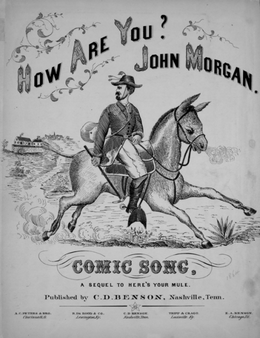
Typical comprehend of sheet music, with songs depicting the individuals of the era, such as John Chase Morgan
During the American Civil State of war, music played a prominent role on both sides of the conflict, Union (the North) and Confederate (the S). On the battlefield, unlike instruments including bugles, drums, and fifes were played to outcome marching orders or sometimes simply to boost the morale of one's fellow soldiers. Singing was also employed not simply as a recreational activity just equally a release from the inevitable tensions that come with fighting in a war. In camp, music was a diversion abroad from the mortality, helping the soldiers deal with homesickness and boredom. Soldiers of both sides often engaged in recreation with musical instruments, and when the opposing armies were most each other, sometimes the bands from both sides of the disharmonize played against each other on the nighttime before a boxing.
Each side had its detail favorite tunes, while some music was enjoyed by Northerners and Southerners akin, as exemplified by U.s.a. President Abraham Lincoln'south dear of "Dixie", the unofficial anthem of the Confederacy. To this day, many of the songs are sung when a patriotic piece is required. The war's music likewise inspired music artists such equally Lynyrd Skynyrd and Elvis Presley.
Development of American music [edit]

The Civil State of war was an important menstruum in the development of American music. During the Civil War, when soldiers from across the country commingled, the multifarious strands of American music began to cross-fertilize each other, a process that was aided by the burgeoning railroad manufacture and other technological developments that fabricated travel and communication easier. Army units included individuals from across the country, and they rapidly traded tunes, instruments, and techniques. The songs that arose from this fusion were "the first American folk music with discernible features that can exist considered unique to America".[i] The state of war was an impetus for the creation of many songs that became and remained wildly popular; the songs were aroused by "all the varied passions (that the Civil War inspired)" and "echoed and re-echoed" every aspect of the state of war. John Tasker Howard has claimed that the songs from this era "could exist arranged in proper sequence to form an actual history of the conflicts: its events, its master characters, and the ideals and principles of the opposing sides".[two]
In addition to, and in conjunction with, popular songs with patriotic fervor, the Civil War era too produced a great torso of brass band pieces, from both the North and the South,[3] every bit well as other armed services musical traditions like the bugle telephone call "Taps".
Regulations [edit]

John Clem, a twelve-yr-old Union drummer boy
In May 1861, the The states War Department officially canonical that every regiment of infantry and arms could have a brass band with 24 members, while a cavalry regiment could have 1 of sixteen members. The Confederate regular army would besides have brass bands. This was followed by a Union army regulation of July 1861 requiring every infantry, artillery, or cavalry company to have two musicians and for at that place to be a twenty-four human ring for every regiment.[4] The July 1861 requirement was ignored as the war dragged on, as riflemen were more needed than musicians. In July 1862 the contumely bands of the Union were disassembled past the adjutant general, although the soldiers that comprised them were sometimes re-enlisted and assigned to musician roles. A survey in October 1861 found that 75% of Union regiments had a band.[4] By December 1861 the Wedlock regular army had 28,000 musicians in 618 bands; a ratio of one soldier out of 41 who served the army was a musician, and the Confederate army was believed to have a similar ratio.[five] Musicians were oftentimes given special privileges. Union general Philip Sheridan gave his cavalry bands the best horses and special uniforms, believing "Music has done its share, and more than its share, in winning this war".[vi]
Musicians on the battlefield were drummers and buglers, with an occasional fifer. Buglers had to learn xl-nine separate calls but for infantry, with more than needed for cavalry. These ranged from battle commands to calls for meal time.[vii] Some of these required musicians were drummer boys not even in their teens, which allowed an adult man to instead be a foot soldier. The most notable of these under anile musicians was John Clem, also known as "Johnny Shiloh". Matrimony drummers wore white straps to back up their drums. The drum and band majors wore baldrics to indicate their status; later on the war, this style would be emulated in civilian bands. Drummers would march to the right of a marching column. Like to buglers, drummers had to learn 39 different beats: 14 for general use, and 24 for marching cadence. However, buglers were given greater importance than drummers.[8]
On the battlefield [edit]
Whole songs were sometimes played during battles. The survivors of the disastrous Pickett'southward Charge returned under the tune "Nearer My God to Thee".[ix] At the Battle of Five Forks, Union musicians under orders from Sheridan played Stephen Foster'south minstrel vocal "Nelly Bly" while being shot at on the front lines.[9] Samuel P. Heintzelman, the commander of the III Corps, saw many of his musicians standing at the back lines at the Battle of Williamsburg, and ordered them to play anything.[9] Their music rallied the Union forces, forcing the Confederate to withdraw. It was said that music was the equivalent of "a thou men" on one's side. Robert Due east. Lee himself said, "I don't think nosotros could have an army without music."[10]
Sometimes, musicians were ordered to leave the battlefront and assist the surgeons. One notable time was the 20th Maine'southward musicians at Little Round Elevation. As the rest of the regiment were driving back wave after wave of Confederates, the musicians of the regiment were not simply performing amputations, simply doing it in a very quick manner.[11] [12]
In camp [edit]

Many soldiers brought musical instruments from abode to pass the time at camp. Banjos, fiddles, and guitars were particularly popular. Aside from drums, the instruments Confederates played were either acquired earlier the war or imported, due to the lack of contumely and the industry to brand such instruments.[11] [13]
Musical duels betwixt the ii sides were common, every bit they heard each other as the music traveled across the countryside. The night before the Boxing of Stones River, bands from both sides dueled with split songs until both sides started playing "Home! Sweet Home!", at which fourth dimension soldiers on both sides started singing together equally one.[14] A similar situation occurred in Fredericksburg, Virginia, in the winter of 1862–63. On a cold afternoon, a Matrimony band started playing Northern patriotic tunes; a Southern band responded by playing Southern patriotic tunes. This dorsum and forth continued into the night, until at the cease both sides played "Home! Sweet Dwelling house!" simultaneously, to the cheers of both sides' forces.[eleven] In a third instance, in the bound of 1863, the opposing armies were on the opposite sides of the Rappahannock River in Virginia, when the different sides played their patriotic tunes, and at taps one side played "Home! Sweetness Dwelling!", and the other joined in, creating "thanks" from both sides that echoed throughout the hilly countryside.[fifteen]
Both sides sang "Maryland, My Maryland", although the lyrics were slightly different. Another pop song for both was "Lorena". "When Johnny Comes Marching Domicile" was written in 1863 past Patrick Gilmore, an immigrant from Ireland, and was also enjoyed by both sides.[16] [17]
Homefront [edit]

The first vocal was written for the war, "The Kickoff Gun Is Fired", was first published and distributed iii days afterward the Boxing of Fort Sumter. George F. Root, who wrote it, is said to have produced the near songs of anyone about the state of war, over thirty in total.[eighteen] Lincoln in one case wrote a letter to Root, saying, "You have done more a hundred generals and a k orators."[19] Other songs played an important role in disarming northern whites that African Americans were willing to fight and wanted freedom, for instance Henry Clay Piece of work'due south 1883 "Babylon Is Fallen" and Charles Halpine's "Sambo's Right to Be Kilt".[20]

The southern states had long lagged backside northern states in producing common literature. With the advent of war, Southern publishers were in demand. These publishers, based largely in v cities (Charleston, Southward Carolina; Macon, Georgia; Mobile, Alabama; Nashville, Tennessee; and New Orleans, Louisiana), produced five times more than printed music than they did literature.[21]
In the Amalgamated States of America, "God Save the South" was the official national canticle. All the same, "Dixie" was the virtually pop.[17] Us President Abraham Lincoln said he loved "Dixie" and wanted to hear information technology played, saying "every bit we had captured the rebel army, we had also captured the rebel tune".[22] At an April nine, 1865, rally, the band director was surprised when Lincoln requested that the ring play "Dixie". Lincoln said, "That tune is now Federal holding ... good to testify the rebels that, with us in power, they will exist free to hear it again." The other prominent tune was "The Bonnie Blue Flag", which, like "Dixie", was written in 1861, different Matrimony popular tunes which were written throughout the war.[23]
The United States did not take a national anthem at this time ("The Star-Spangled Imprint" would non be recognized every bit such until the twentieth century). Marriage soldiers ofttimes sang the "Battle Weep of Freedom", and the "Battle Hymn of the Republic" was considered the north's most pop vocal.[24]
African American music [edit]
Music sung by African-Americans inverse during the state of war. The theme of escape from bondage became specially important in spirituals sung by blacks, both by slaves singing amidst themselves on plantations and for free and recently freed blacks singing to white audiences. New versions of songs such equally "Hail Mary", "Michael Row the Boat Ashore", and "Go Downwardly Moses" emphasized the message of liberty and the rejection of slavery.[25] Many new slave songs were sung as well, the most popular existence, "Many Thousands Become", which was frequently sung by slaves fleeing plantations to Union Army camps.[26] Several attempts were made to publish slave songs during the war. The first was the publishing of sheet music to "Become Down Moses" past Reverend L. C. Lockwood in December 1861 based on his feel with escaped slaves in Fort Monroe, Virginia, in September of that year. In 1863, the Continental Monthly published a sampling of spirituals from South Carolina in an article titled, "Nether the Palmetto".[27]
The white colonel of the all-black First South Carolina, Thomas Wentworth Higginson, noted that when blacks knew that whites were listening, they changed the style they were sung, and historian Christian McWhiter noted that African Americans "used their music to reshape white perceptions and foster a new image of black civilization as thriving and ready for liberty".[28] In Port Royal, escaped slaves learned the anthem, "America" in secret, never singing it in front of whites. When the Emancipation Proclamation was passed, a celebration was held, and in a surprise to white onlookers, contrabands began singing the canticle, using the song to express their new status.[29] The most popular white songs among slaves were "John Brownish's Body" and H. C. Work's "Kingdom Coming",[30] and as the war continued, the lyrics African Americans sung changed, with vagueness and coded linguistic communication dropped and including open up expressions of their new roles as soldiers and citizens.[31]
Slave owners in the south responded past restricting singing on plantations and imprisoning singers of songs supporting emancipation or the North.[32] Confederate supporters also looked to music sung past slaves for signs of loyalty. Several Confederate regimental bands included slaves, and Confederates bundled slaves to sing and trip the light fantastic toe to show how happy they were. Slave performer Thomas Greene Bethune, known as Blind Tom, frequently played pro-Amalgamated songs such as "Maryland, My Maryland" and "Dixie" and dropped, "Yankee Doodle" from his performances.[33]
Dissimilar versions [edit]
Although certain songs were identified with one particular side of the war, sometimes the other would accommodate the song for their use. A Southern revision of "The Star-Spangled Banner" was used, entitled "The Southern Cross". In an example of the different lyrics, where the "Banner" had "O say does that Star Spangled Imprint yet moving ridge", the "Cross" had "'Tis the Cross of the South, which shall e'er remain".[34] Another Amalgamated version of The Star-Spangled Banner", called "The Flag of Secession", replaced the same poetry with "and the flag of secession in triumph doth wave".[22] Even a song from the American Revolutionary War was adapted, equally the tune "Yankee Doodle" was inverse to "Dixie Doodle", and started with "Dixie whipped old Yankee Doodle early in the morning time".[35] The Wedlock's "Battle Cry of Freedom" was too altered, with the original lines of "The Union forever! Hurrah, boys, hurrah! Down with the traitor, upwardly with the star" beingness changed to "Our Dixie forever! She'south never at a loss! Down with the eagle and up with the cross!"[36]
The Matrimony also adjusted Southern songs. In a Union variation of "Dixie", instead of the line "I wish I was in the land of cotton wool, former times in that location are not forgotten, Wait away, look away, look away, Dixie Land", it was changed to "Away downward Southward in the land of traitors, Rattlesnakes and alligators, Right away, come away, correct abroad, come abroad".[37] "John Brown'south Body" (originally titled "John Brown") was originally written for a soldier at Fort Warren in Boston in 1861. It was sung to the tune of "Glory, Hallelujah" and was after used by Julia Ward Howe for her famous verse form, "Battle Hymn of the Republic".[38]
Classical music [edit]
- A Lincoln Portrait (1942), past Aaron Copland, for narrator and orchestra. The field of study is Lincoln's words. Contains excerpts from his 1862 almanac address to Congress, the Lincoln-Douglas Debates, and the Gettysburg Address. The narrator is unremarkably a distinguished person the orchestra wishes to honor; amid them have been Beak Clinton, Al Gore, and Barack Obama.
- "The Battle of Shiloh" (1886), by C. L. Barnhouse, march for military band. The subject is the battle of the aforementioned name.
- Names from the War (1961), by Alec Wilder, for narrator with chorus, woodwinds, and contumely. Sets to music a long poem of the aforementioned proper name by Civil War historian Bruce Catton. 100 years after, what remains are the names.
Legacy [edit]

The music derived from this war was of greater quantity and variety than from whatsoever other state of war involving America.[39] Songs came from a variety of sources. "Battle Hymn of the Republic" borrowed its tune from a song sung at Methodist revivals. "Dixie" was a minstrel song that Daniel Emmett adjusted from ii Ohio black singers named Snowden.[40] American soldiers would proceed to sing "Battle Hymn of the Republic" in the Spanish–American War, World War I, and World State of war II.[41]
The Southern rock style of music has oftentimes used the Confederate Boxing Flag equally a symbol of the musical style. "Sweetness Home Alabama" past Lynyrd Skynyrd was described as a "vivid case of a lingering Amalgamated mythology in Southern culture".[42]
A carol from the war, "Aura Lee", would become the footing of the vocal "Love Me Tender" by Elvis Presley. Presley also sang "An American Trilogy", which was described as "smoothing" out "All My Trials", the "Battle Hymn of the Democracy", and "Dixie" of its divisions, although "Dixie" however dominated the piece.[43]
In 2013, a compilation album by current pop musicians, like Jorma Kaukonen, Ricky Skaggs, and Karen Elson, was released with the championship Divided & United: The Songs of the Civil War.[44]
Songs published per twelvemonth [edit]
westward. = Words by
m. = Music past
1861 [edit]
- "The Outset Gun is Fired", w.grand. George F. Root
- "The Bonnie Bluish Flag", due west. Mrs. Annie Chamber-Ketchum, m. Harry MacCarthy
- "Dixie", due west. Dan Emmett a. C. Southward. Grafully
- "John Chocolate-brown's Body", w. bearding m. William Steffe (came to be the unofficial theme vocal of blackness soldiers)
- "Maryland, My Maryland", w. James Ryder Randall thou. Walter de Mapers (Music "Mini est Propositum" twelfth century)
- "The Vacant Chair", westward. Henry S. Washburne chiliad. George Frederick Root
1862 [edit]
- "Here'south Your Mule", C. D. Benson
- "Battle Cry of Freedom", George F. Root
- "Battle Hymn of the Republic", Julia Ward Howe
1863 [edit]

Encompass of the 1864 publication of the canvass music of "Tramp! Tramp! Tramp!"
- "All Placidity Along the Potomac Tonight", w.m. John Hill Hewitt
- "Just Earlier the Battle, Mother", past George F. Root
- "Mother Would Comfort Me", w.m. Charles C. Sawyer
- "Tenting on the Old Camp Footing", w.m. Walter Kittredge
- "Weeping Sad and Lonely", west. Charles Carroll Sawyer m. Henry Tucker
- "When Johnny Comes Marching Home", by Patrick Gilmore
- "Y'all Are Going to the Wars, Willie Boy!", w.m. John Hill Hewitt
- "The Immature Volunteer", w.chiliad. John Hill Hewitt
1864 [edit]
- "Tramp! Tramp! Tramp! (The Boys Are Marching)", w.yard. George F. Root
- "Pray, Maiden, Pray!", w. A. West. Kercheval, chiliad. A. J. Turner
1865 [edit]
- "Jeff in Pettycoats", westward.m. Henry Tucker
- "Marching Through Georgia", w.m. Henry Clay Work
- "Expert Adieu, Sometime Glory", w. L. J. Bates, m. George Frederick Root
Notes and references [edit]
Notes [edit]
- ^ Struble, p. xvii
- ^ Howard, John Tasker, cited in Ewen, p. 19 (no specific source given)
- ^ "Ring Music from the Civil War Era", Library of Congress
- ^ a b Lanning p. 243
- ^ Lanning p. 243, Vaughan pp. 194, 195
- ^ Lanning, p. 244
- ^ Amedeo, p. 127; Miller, p. 92
- ^ Lanning p. 243; Miller p. 96
- ^ a b c Lanning p. 244
- ^ Lanning pp. 243, 244
- ^ a b c "Music of the Civil War", National Park Service
- ^ Turner p. 151; Vaughan p. 195
- ^ Heidler p. 1173; Miller p. 190
- ^ Amedeo p. 257; Vaughan p. 194
- ^ Branham p. 131
- ^ Amedeo, pp. 77, 127
- ^ a b Lanning p. 245
- ^ Kelley p. 30; Silber p. 7
- ^ Branham p. 132
- ^ McWhirter 2012, p. 148
- ^ Harwell, pp. 3, iv
- ^ a b Branham p. 130
- ^ Silber, p. viii
- ^ Lanning p. 245
- ^ McWhirter 2012, pp. 149–150, 157
- ^ McWhirter 2012, p. 151
- ^ McWhirter 2012, p. 155–156
- ^ McWhirter 2012, p. 152
- ^ McWhirter 2012, p. 158–159
- ^ McWhirter 2012, p. 159
- ^ McWhirter 2012, p. 163
- ^ McWhirter 2012, pp. 152–153
- ^ McWhirter 2012, p. 154
- ^ Harwell pp. 64, 65
- ^ Harwell, p. 67
- ^ Silber p. 10
- ^ Van Deburg p. 109
- ^ Hall, p. 4
- ^ Silber, p. four
- ^ Heidler pp. 191, 607
- ^ Ravitch p. 257
- ^ Kaufman pp. ten, 81
- ^ Amedeo, p. 111, Kaufman, p. 83
- ^ Doughtery, Steve, "Civil State of war Popular Music: Divided & United: On a new CD, contemporary artists revive the era's songs", The Wall Street Journal, Oct 23, 2013
References [edit]
- Amedeo, Michael (2007). Civil State of war: Untold stories of the Blue and the Gray . Due west Side Publications. ISBN978-i-4127-1418-1.
- Branham, Robert J. (2002). Sweet Freedom's Song: "My Land 'tis of Thee" and Republic in America . Oxford Academy Printing US. ISBN0-nineteen-513741-8.
- Ewen, David (1957). Panorama of American Popular Music . Prentice Hall.
- Hall, Roger Lee (2012). Glory, Hallelujah: Civil War Songs and Hymns. PineTree Printing.
- Harwell, Richard B. (1950). Confederate Music. Chapel Colina, North Carolina: University of North Carolina Press. OCLC 309959.
- Heidler, David (2002). Encyclopedia of the American Civil War. W. West. Norton. ISBN0-393-04758-X.
- Kaufman, Volition (2006). The Ceremonious War in American Culture. Edinburgh University Press. ISBN0-7486-1935-6.
- Kelley, Bruce (2004). "An Overview of Music of the Ceremonious War Era" Bugle Resounding. Academy of Missouri Printing. ISBN0-8131-2375-5.
- Lanning, Michael (2007). The Civil State of war 100. Sourcebooks. ISBN978-1-4022-1040-2.
- McWhirter, Christian (2012). Battle Hymns: The Power and Popularity of Music in the Ceremonious War. Chapel Colina, North Carolina: Academy of Due north Carolina Press. ISBN978-1469613673.
- Miller, David (2001). Uniforms, Weapons, and Equipment of the Ceremonious War. London: Salamander Books. ISBNone-84065-257-8.
- Ravitch, Diane (2000). The American Reader: Words that Moved a Nation. HarperCollins. ISBN0-06-273733-three.
- Silber, Irwin (1995). Songs of the Civil War . Courier Dover Publications. ISBN0-486-28438-7.
- Struble, John Warthen (1995). The History of American Classical Music. Facts on File. ISBN0-8160-2927-Ten.
- Turner, Thomas Reed (2007). 101 Things Yous Didn't Know about the Civil War. Adams Media. ISBN978-i-59869-320-1.
- Van Deburg, William L. (1984). Slavery & Race in American Pop Culture . Academy of Wisconsin Press. ISBN0-299-09634-three.
- Vaughan, Donald (2000). The Everything Civil State of war Volume . Holbrook, Massachusetts: Adams Media Corporation. ISBN1-58062-366-2.
Further reading [edit]
- Abel, E. Lawrence (2000). Singing the New Nation: How Music Shaped the Confederacy, 1861–1865 (First ed.). Mechanicsburg, Pennsylvania: Stackpole Books. ISBN0-8117-0228-six.
- Clarke, Donald (1995). The Rise and Fall of Popular Music. St. Martin's Press. ISBN0-312-11573-3.
- Donald, David Herbert (1995). Lincoln . Simon and Schuster. ISBN0-684-82535-X.
- Knouse, Nola Reed "Music from the Band Books of the 26th Infantry Regiment, NC Troops, C.South.A.". Liner notes essay. New World Records.
- Southern, Eileen (1997). The Music of Black Americans. New York: Westward. Westward. Norton. pp. 206–212. ISBN0-393-97141-4.
External links [edit]
- "Drove: Band Music From the Civil State of war Era". Library of Congress . Retrieved June 13, 2005.
- The short pic A Nation Sings (1963) is bachelor for free download at the Internet Archive.
- Singing the Songs of Zion: Soldier's Hymn Collections and Hymn Singing in the American Civil War
- Civil War songs and hymns
- American Vocal Sheets, Duke Academy Libraries Digital Collections – includes images and text of over 1,500 Ceremonious War vocal sheets
- Ceremonious State of war-era pictorial envelopes and song sheets at the Academy of Maryland Libraries
Source: https://en.wikipedia.org/wiki/Music_of_the_American_Civil_War
0 Response to "Reading Passage of the Star Spangled Banner"
Enviar um comentário