Read Survive Water Crisis Guide by Damien Campbell Free
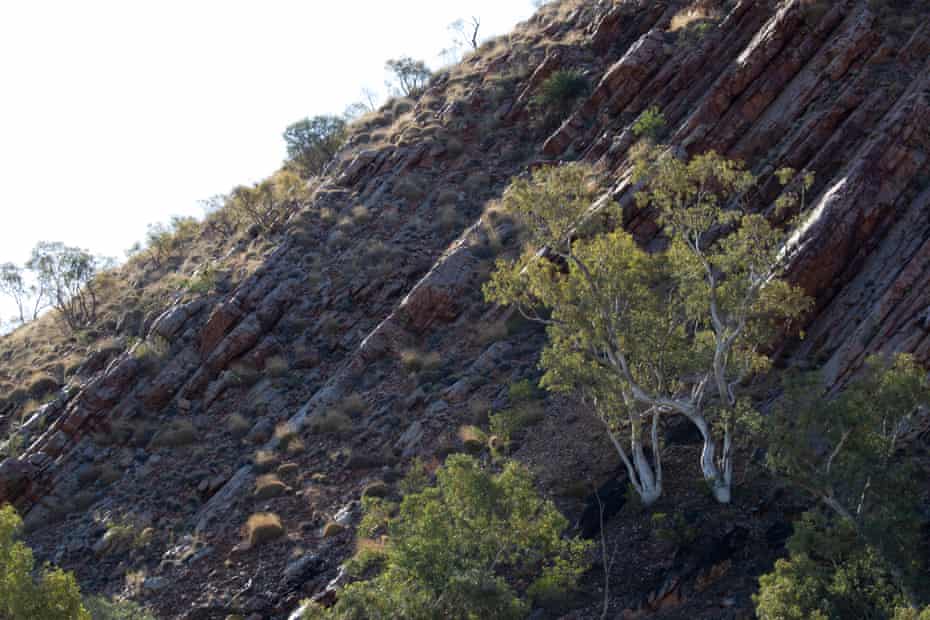
J osie Douglas sits on a verandah overlooking a ridge of red rocks and earth, scrubby with saltbush and spinifex near the centre of Alice Springs. It's late afternoon and only 31C – a reprieve from a run of days in the loftier 30s and 40s.
But Douglas knows that from now on it will only get hotter.
Last summer was the hottest on record, and the driest in 27 years in central Australia. Five per cent of the boondocks's street trees died. A estrus monitoring study showed that on some unshaded streets the surface temperature was between 61C and 68C.
"We tin't keep going on the fashion nosotros're going," says Douglas, who is manager of policy and enquiry at the Central State Quango.
"Cardinal Australian Aboriginal people are very resilient. They have evolved to cope with the harsh and variable desert climate, but there are limits.
"Without action to stop climate change, people will exist forced to leave their country and leave behind much of what makes them Aboriginal. Climatic change is a clear and present threat to the survival of our people and their culture."
Across central Commonwealth of australia, people are bracing themselves for another scorching summer of drought.
At least nine remote communities and outstations are running out of water. A further 12 have reported poor quality drinking water every bit aquifers run depression and the remaining supply is saline.
Temperature records have already been broken. In the year to July 2019, Alice Springs had 129 days over 35C, and 55 days over 40C.
Information technology wasn't meant to be like this – at to the lowest degree, not yet. The national science agency, the CSIRO, predictedthat these temperatures would not arrive until 2030.
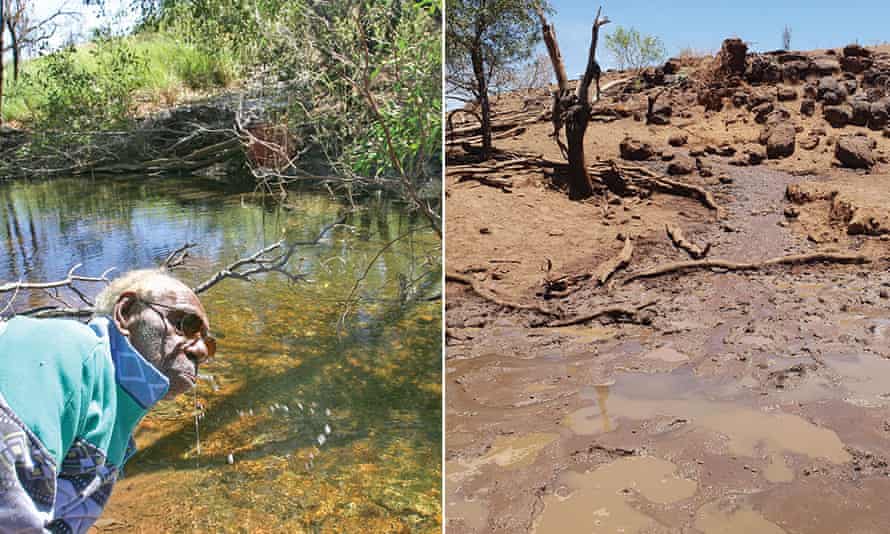
As the Northern Territory's surround minister, Eva Lawler, said last September: "If we don't do annihilation, the NT will get unliveable."
The trouble is where to start.
In Alice Springs stance is divided among local politicians about the impact climatic change is having on life in the desert.
Sitting on the grassy lawn outside the council, Jimmy Cocking of the Barren Lands Surroundings Centre talks openly about climate refugees: those who have already come into town, and those who volition have to come in the near future.
"Nosotros're going to end upwardly with a whole bunch of internally displaced people within the Northern Territory in remote Australia, if we're not planning for that," he says.
"If regional centres like Alice Springs and others aren't planning to be able to bargain with the influx of climate refugees internally within our region, nosotros're going to exist left flatfooted and unable to deal with any of the challenges and social consequences that volition come from that."
Cocking is on the town council and has sought to pass motions to declare a climate emergency. But the mayor, Damien Ryan, is reluctant to sound the climate alarm.
"In local regime speak, when you accept an emergency, you shut information technology down," Ryan says.
"I have not had whatsoever of the people who talk virtually an emergency say what is the next step. And then you declare an emergency, what do you do and then the next twenty-four hours? That'southward never been made articulate to me."
At its October coming together, the quango did not concur on the give-and-take "emergency" only voted unanimously to say there was an "escalating urgency for climate action".
Douglas and the CLC say Aboriginal communities are doing what they can.
"People are already mitigating climate alter through traditional burning and they are investing their income from land use agreements to install solar ability, plant bush tucker gardens in communities and operate swimming pools, only all that counts for little in the face of the lack of climate leadership from the authorities," she says.
'You lot see people hosing their brick houses'
The NT government says it has allocated $15m to "revitalising" the Alice Springs city center. Some of those funds will become towards shade and landscaping to assistance cool the streets, and to public water stations. Ryan says the council is encouraging local schools to plant more copse.
The Territory authorities says it has a climate change response strategy and is working with other governments and the Bureau of Meteorology to "develop national guidelines for the development of a warning system for extreme heat events".
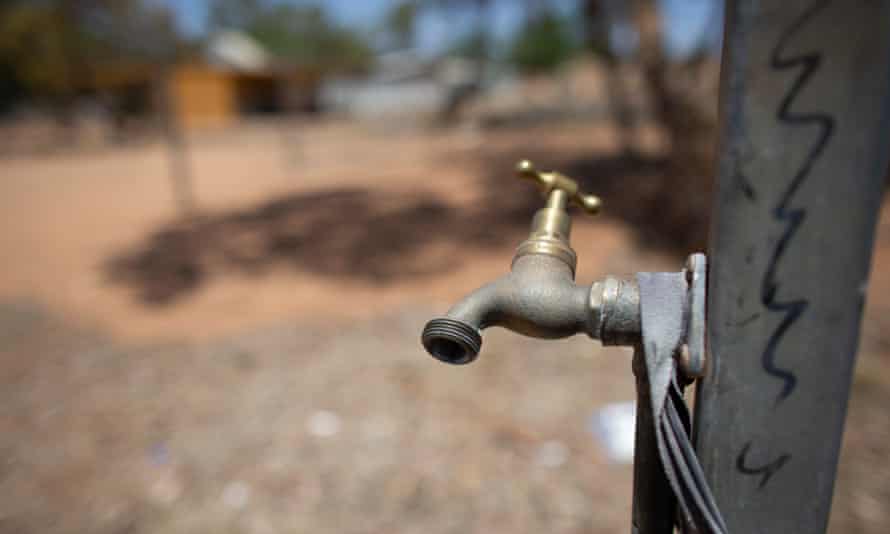
In the meantime, Douglas says, people are living in houses that are "unbearable".
"During our summers you can sometimes meet people in communities hosing the exterior of their Besser brick walls with garden hoses to go on absurd despite the water shortages – that'southward how drastic they are."
Well-nigh 3ookm north-due west of Alice Springs is Yuendumu, the largest remote customs in cardinal Commonwealth of australia. Its 900 or and so residents are facing summertime without a reliable supply of adequate drinking water.
The NT government has stopped building new housing because at that place isn't enough water in the dwindling aquifer to adjust more people.
Yuendumu is not alone.
The Central State Council's chief executive, Joe Martin-Jard, says that at every regional meeting, water security is top of the agenda.
"Between Alice Springs and Mount Isa, there's probably just one major community with a decent water supply," Martin-Jard says. "We're non getting the rain nosotros used to, to recharge the aquifers. Then as water is fatigued out of the aquifers information technology becomes more saline and less beverage [drinkable].
"It'due south a really horrible dilemma."
The NT's Ability and Water Corporation, which is responsible for essential services in 72 remote communities and outstations, says most communities in the arid region are "faced with some level of water stress" and emergency planning is under way, but there are "rarely whatsoever simple solutions".
"The difficult reality is that many communities originally developed historically in locations where there was never any secure, reliable, high quality water resources in shut proximity," a spokesperson said. "As those communities have grown … and expectations of improved levels of service take accordingly increased, the challenges also go along to increase."
Power and Water says more drilling programs are planned merely "finding new water sources is very challenging and often these drilling programs have moderate prospects for success".
"Without big or extended rainfall … the water security risks will progressively increase in some centres, with an increased likelihood that source supply capacity at some could fail."
At to the lowest degree 12 communities accept reported poor quality drinking h2o. At Laramba, Willowra and Wilora, nitrates and uranium are at levels exceeding health guidelines. NT Power and Water says it is "investigating culling technology options". It has already installed treatment plants at Kintore, Ali Curung and Yuelamu to reduce high levels of nitrates, uranium and fluoride.
Full Story
Is central Australia too hot for humans?
00:00:00
00:26:31
'Air conditioning is essential in the desert'
In Alice Springs' xviii town camps, where people from out bush-league ofttimes end up, houses are commonly congenital from Besser bricks – hollow concrete blocks which are cheap, simply which trap the heat. There's a lack of tree encompass or other kinds of shade. Houses bake in the sun and, while the majority accept solar panels, they often accept only an evaporative air workout unit of measurement, known locally as a "swampy", to cool the house.
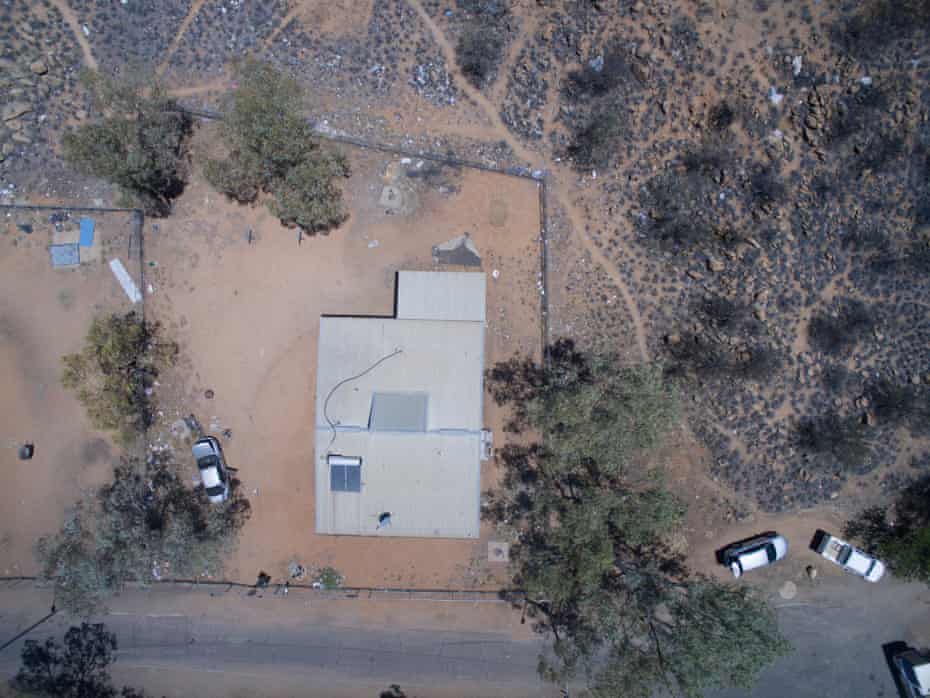
A "swampy" uses a lot of water and can struggle on hot days, especially when there are a lot of people sharing a house, which is mutual in town camps with large families and fluctuating populations.
"Air conditioning is an essential item in the desert, not a luxury," the CLC's Josie Douglas says, "but information technology does not come up standard." When remote community and town camp tenants are offered housing, at that place is "a pigsty where the aircon unit should be and they are told to buy it themselves".
"Many can simply afford to 'shut the gap' with a piece of wood, or run expensive reverse-cycle aircon very sparingly," she says. "Some places don't take enough water to use a cheaper swampy."
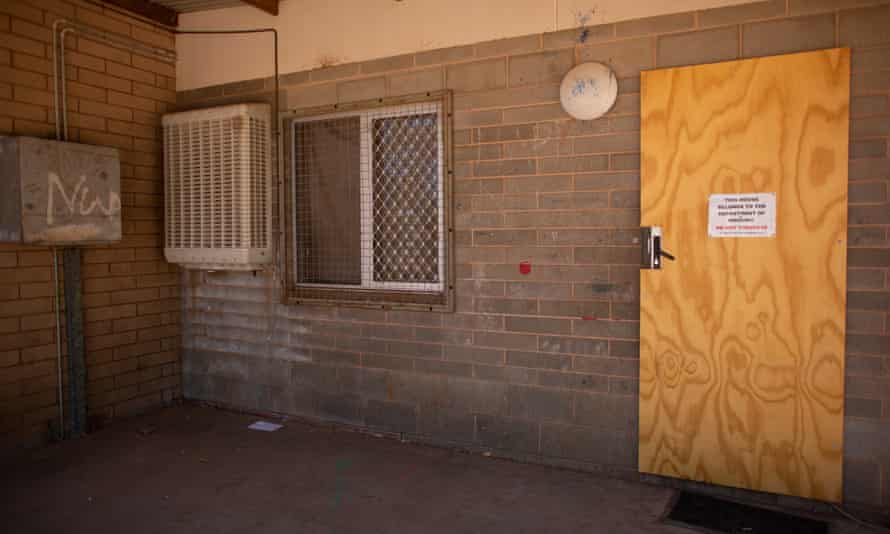
Houses that don't cool downwardly overnight create big health and social problems.
"People resort to sleeping exterior, or cramming everybody into the coolest room of the firm, with all the well-known consequences for the spread of diseases that whitefellas only know from medical textbooks.
"It's also common for people to sleep in shifts, with immature people roaming the streets at night where they get into trouble, and sleeping during the day when they should be at school."
This is at odds with the NT regime's view of the quality of town camp and remote customs housing. A government spokesperson tells Guardian Australia that homes are designed with atmospheric condition weather condition and regional climate in mind, and they include external shading, natural ventilation and insulation.
"Investment into housing in town camps has included the installation of louvres, sunscreens, verandas and insulation," the spokesperson said. "The Department of Housing and Community Development has as well upgraded some primal community infrastructure including improved shading and the installation of fans."
Douglas is calling on the government to "stop edifice physical hotboxes".
"More than a decade ago, the regime and the CLC were partners [in research] that came upwards with actually solid recommendations about how to make desert houses more energy-efficient and communities more resilient.
"Some measures, such as making sure houses are built with the right orientation … and accept passive cooling and a white roof, cost almost nothing. We would like to know how many of these expensive research findings have been implemented in our region."
Shirleen Campbell is a Warlpiri and Arrernte woman who grew up at Hoppy'south Camp, or Lhenpe Artnwe. She told the Alice Springs climate rally in October that boondocks campers were very worried about climate modify.
"This is our identify," she said. "If information technology gets too hot, if we suffer through endless droughts or we spoil our water, then we don't take another identify to go.
"We want houses that are right for this identify and right for our people. We want to invest in renewable energy, like solar."
Campbell is a co-coordinator of the women'south family safety group at Tangentyere quango, which delivers services to and advocates on behalf of boondocks camp residents.
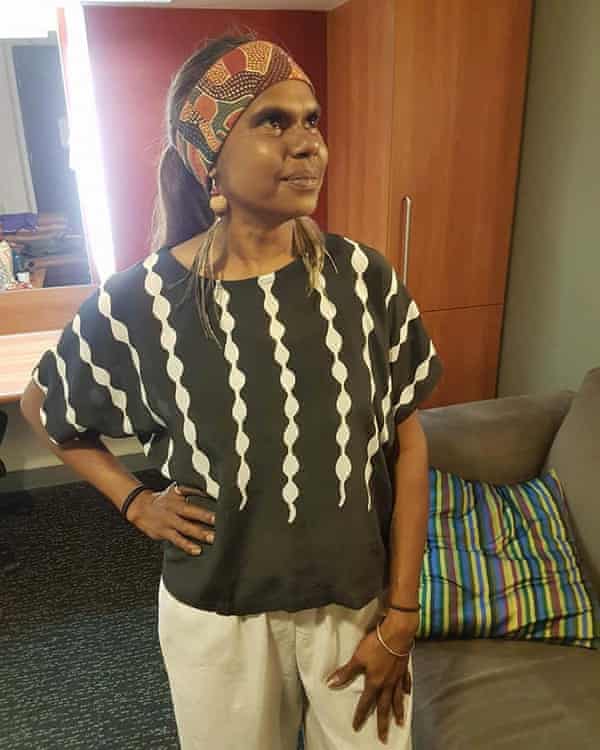
"Near of all we want people to care for this place as a legacy to be handed down to our children and grandchildren. It is not a speculative commodity and it is non something to be sold or exported.
"We have been hither for a long time and want to expect afterwards this place for those that come after."
Keeping cool in the library
There are few public places in Alice Springs to cool off. The Yeperenye shopping heart has security guards at the doors and, according to Douglas and Campbell, Aboriginal people are regularly moved on.
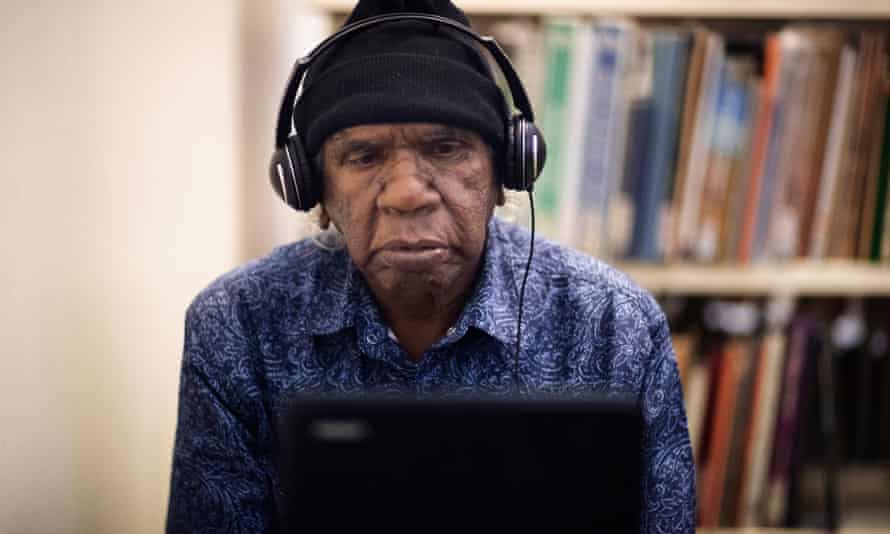
The library is a popular, free cool space. In that location's a widescreen TV rigged up with headphones, showing movies. Westerns are pop, as are replays of AFL chiliad finals. The Saltbush room downwardly the hall is a haven for older folk, while piffling mobs of kids hang out among the immature adult stacks or cluster around the phone-charging station.
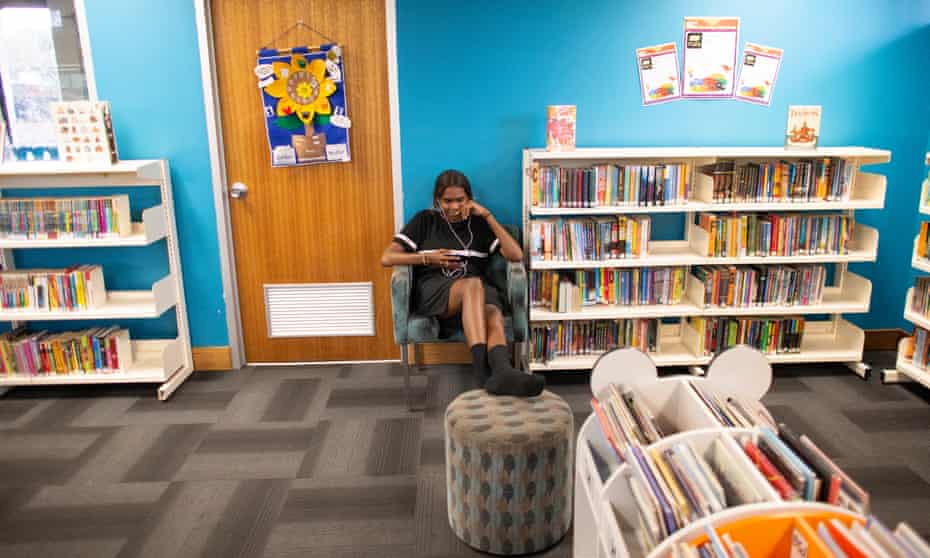
"We found there's a gap in later-school care services from virtually two.30 to iv.thirty, the hottest time of the day," says the head librarian, Clare Fisher. "The kids tin come up to the library, cool off, take fruit and sandwiches."
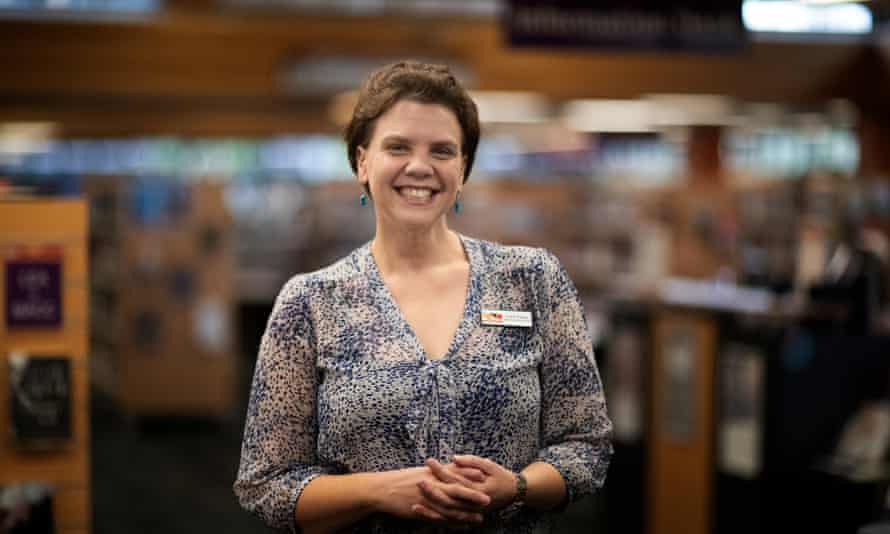
"Libraries are for connectedness and relaxation as well as knowledge. We make everyone welcome – just we explain how to use the library and how to carry as well. We very much believe in come and be who you are."
Thirsty and dying animals culled
In January footage of dead and dying horses in a dry creek bed at Ltyentye Apurte, 80km s-e of Alice Springs, flashed around the world.
The Ltyentye Apurte rangers had the unenviable task of dragging more than 100 dead horses from the creek bed and disposing of their bodies.

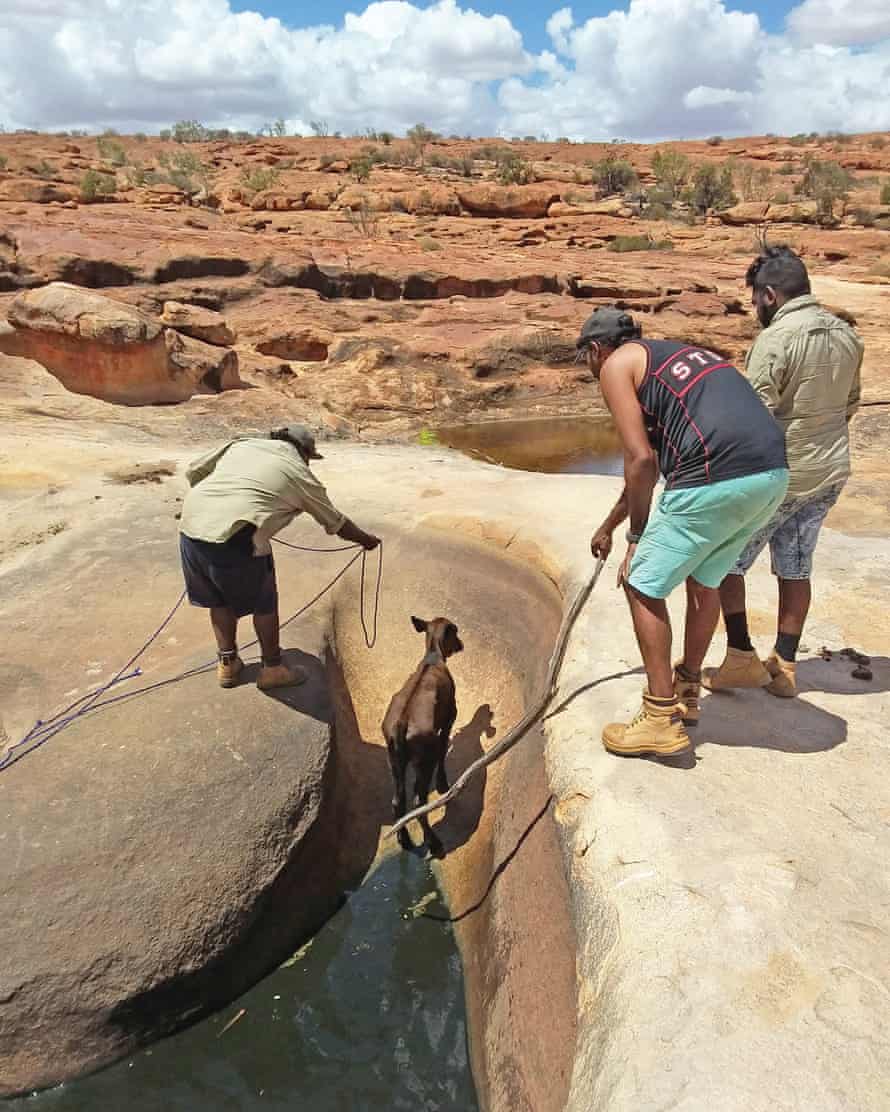
In June the CLC conducted an emergency choose of more than than 1,400 feral horses, donkeys, camels and cattle from a waterhole near Lajamanu. The animals were thirsty and dying, congregating around the last remaining springs and h2o sites.
The CLC has eradicated vi,279 feral animals in preparation for summer. Traditional owners don't usually support animal culls, the CLC says, only there were no alternatives, with so many animals dying or in poor status.
Feral animals harm customs infrastructure and housing. Thirsty camels, for example, volition attack air conditioning units because they smell water, and lay waste to water tanks, bores, fences, pipes and taps.
How hot is besides hot? Oestrus, health and housing hotboxes
In town, Tangentyere council wants to measure exactly how well houses are functioning.
Tangentyere'due south social policy and enquiry director, Michael Klerk, is in discussions with the CSIRO to install temperature data loggers in people's houses, to build a case for improvements that are taken for granted elsewhere: solar power, insulation, ameliorate air-conditioning, broad awnings, more shade.
"Last summer – which was a very hot summer, before long to be repeated – a lot of anecdotal feedback was that people'southward evaporative air conditioners weren't cooling the houses sufficiently," Klerk says.
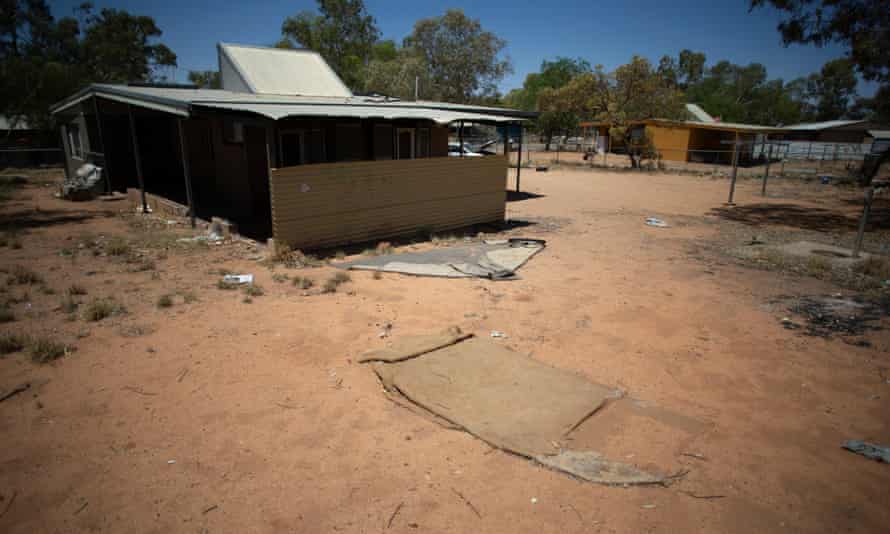
"This probably reflects the reality that evaporative air conditioners are not proficient at cooling houses when the external temperatures are in the mid-40s.
"You might drib the temperature of a firm to mid-30s, simply that's not an optimal internal ambient temperature for comfort or for health."
Most people living in boondocks camps and remote communities, and some in suburban public housing, accept pre-paid electricity meters.
Residents are issued a power card, which they meridian upward with their welfare payments or income. In one case the credit is spent, they have to superlative it up once again, or go without electricity. Klerk says that happened a lot in the terminal quarter of 2018.
In Alice Springs, 420 of 570 households with prepaid electricity meters had at least one self-disconnection, which lasted, on boilerplate, 7.5 hours. Of the 570 Alice Springs meters, 285 are in town camp dwellings.
In result, more than than half the town campers ran out of money to pay for electricity.
"When the power goes off, it is bad for our health, the food gets spoiled, nosotros can't launder our dress and nosotros can't wash our kids," Shirleen Campbell told the rally.
"In summer, when our houses are hot or when we don't accept electricity, our people look for comfort in air-conditioned public places. We are not ever welcome in these places and sometimes there are issues. Nosotros are thankful for places similar the library and the pool."
Klerk says depression-income residents shouldn't have to go bankrupt trying to go along their houses cool. "Information technology's not acceptable that people's houses are making them sick, and something really needs to exist washed about it. Information technology shouldn't all exist passed on to the consumer.

"If information technology's the case of people having to spend more money to keep the houses at a temperature that delivers health outcomes, then we take to rethink the levels of income support that are available to people, specially in these regions where it's so hot."
Predictions by the Central Australian Aboriginal Congress for the health impacts of rut are dire. In its submission to the NT regime's climate change policy discussion newspaper, it outlined some of them: "Increased sickness and mortality due to heat stress, increased food insecurity and malnutrition, increased take a chance from infectious affliction, poorer mental health and an increased potential for social conflict."
'The antitoxin to despair is action'
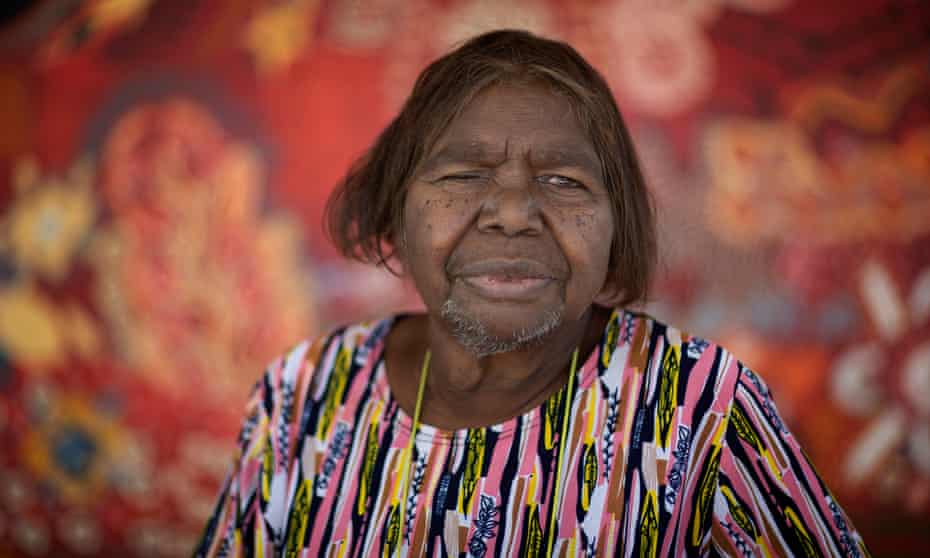
The Pintupi-Luritja artist Irene Nangala was amid the first to return to her home state at Kintore in the western desert, near the border with Western Australia, in the early on 1980s.
Until and then, Pintupi people had been living a long mode from home at the mission at Papunya, and they were homesick.
Nangala helped set upward the Kintore schoolhouse. It was a "windbreak school" at first, she says: simply a tarp to keep the sun and the pelting h2o out.
"And then we got a few teachers. Information technology was difficult work. We've got a proper good schoolhouse now, proper shop. Nice clinic and anile care, child care."
Nangala says she doesn't have an air-conditioner. On hot days the family unit puts blankets on the windows. Other elders whose aircon units suspension down take to look for a repairer to come from Alice Springs, more 10 hours' drive away.
"It'southward really hot in Kintore. Nosotros can't go and sit down exterior. We take to go at night to sit downwards with the families."
Nevertheless, Nangala says she does not want to leave.
"We built upward Kintore,' she says. "People are really enjoying going back to their grandfather's land. That's the right thing to exercise. And it'southward good for them to go dorsum, the old people, good for the heart and the spirit.
"When they went start, they cried, they missed that identify for a long fourth dimension."
Nangala says people don't want to come up into town, where life might be worse.
"Climate change is true," Nangala says. "They [politicians] got the map and weather things, they should meet the temperature what is happening effectually Australia, information technology's and so hot."
Jimmy Cocking says: "We are walking blindly into the new climate reality. We've moved beyond promise, and we can't exist running on hope alone.
"The only thing that is going to go us over the line is action. And the antidote to despair is action.
"So there'due south a lot of things that we need to exist looking to change so that we aren't going to exist putting people'south lives at hazard."
Source: https://www.theguardian.com/australia-news/2019/dec/18/too-hot-for-humans-first-nations-people-fear-becoming-australias-first-climate-refugees
0 Response to "Read Survive Water Crisis Guide by Damien Campbell Free"
Enviar um comentário